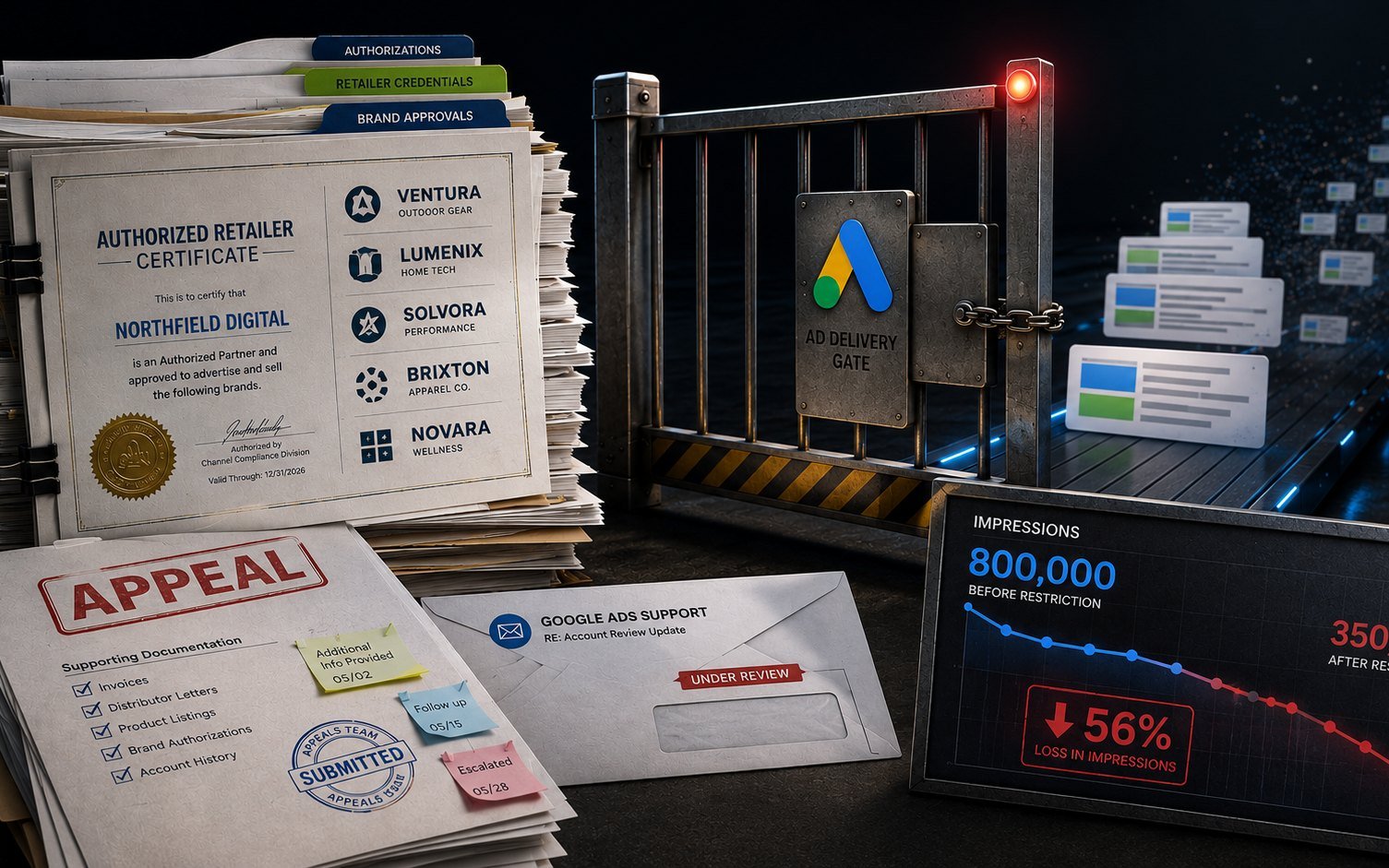
Search Engine Land walks through Google Ads' Limited Ad Serving policy: it does not disapprove your ads, issue a strike, or suspend your account, but it does restrict which otherwise-eligible auctions your account can enter — which shows up as fewer impressions and a higher cost to capture what remains.
Key facts
- Effective: Introduced in 2023 for Search and YouTube; refined in 2026 and expanded to Gmail, the Play Store and Discover, with broader implementation rolling out through 2028
- Who it hits: Accounts bidding on company or product names. Most common in affiliates, insurance, consumer services, third-party lead gen, travel and franchises. New accounts are flagged more often
- Do something?: Yes: audit whether you bid on other companies' brand terms, make sure your landing pages carry your own branding, and check your account for the notification
What happened
Limited Ad Serving is an account-level status that limits how often ads from that account may serve in auctions they are technically eligible for, and Google does not share the criteria determining which auctions you can reach. The article flags two similar-sounding terms not to confuse it with: Eligible (limited) Ads is an ad-level status that usually tells you which countries or age groups are affected, and Limited Ads is an AdSense status about how publishers collect and use personalised data. Author John Horn gives a client case: an authorised retailer for several large brands, a $3 million account, with written agreements permitting use of "authorized retailer" logos and brand names on landing pages and in some ad copy. Google limited the account with no warning. The appeal, contracts attached, was denied almost immediately, and a seven-month fight followed before director-level escalation at Google got it lifted. Monthly impressions fell from 800,000 to 350,000, and even that 350,000 was bought with far more aggressive bidding at higher CPCs and CPAs. Impressions snapped back immediately once the limitation was removed. The most common trigger is targeting company or product names as keywords. A high volume of direct reports or negative online feedback can also trigger the flag, or in some cases an Unacceptable Business Practices suspension. New accounts are flagged more often, but accounts with years of history and millions in spend get hit too. Google shows a notification in the account but does not promise an email; if you dismissed the notification and want to confirm your status, contacting support is the only way to find out.
What it means for DTC sellers
Three kinds of accounts carry the most risk here. First, resellers and authorised retailers who need to bid on upstream brand terms — the case study had signed agreements and still lost seven months, so a contract is not immunity. Second, competitor conquesting, especially in sensitive verticals. Third, brand-new ad accounts, which are flagged more often precisely during the ramp-up period when you most need volume. What to actually do. One: go look in your account right now for the notification, and if you dismissed it at some point, contact support and ask — that is the only reliable way to know. Two: clean up brand assets on landing pages. Your own logo and business name in the header and footer, partner branding only in the body with the relationship spelled out. That is the most directly actionable item in the piece. Three: if a meaningful share of your paid revenue depends on someone else's brand terms, treat that as a single point of failure and build up non-brand and organic share before you have to. One reality worth being blunt about: appeals are not reliable and carry no committed timeline. Seven months is the number in this case study, which makes prevention the only sensible posture. And since the policy is still expanding across Gmail, the Play Store and Discover through 2028, the exposed surface is wider than it was and will not settle soon.