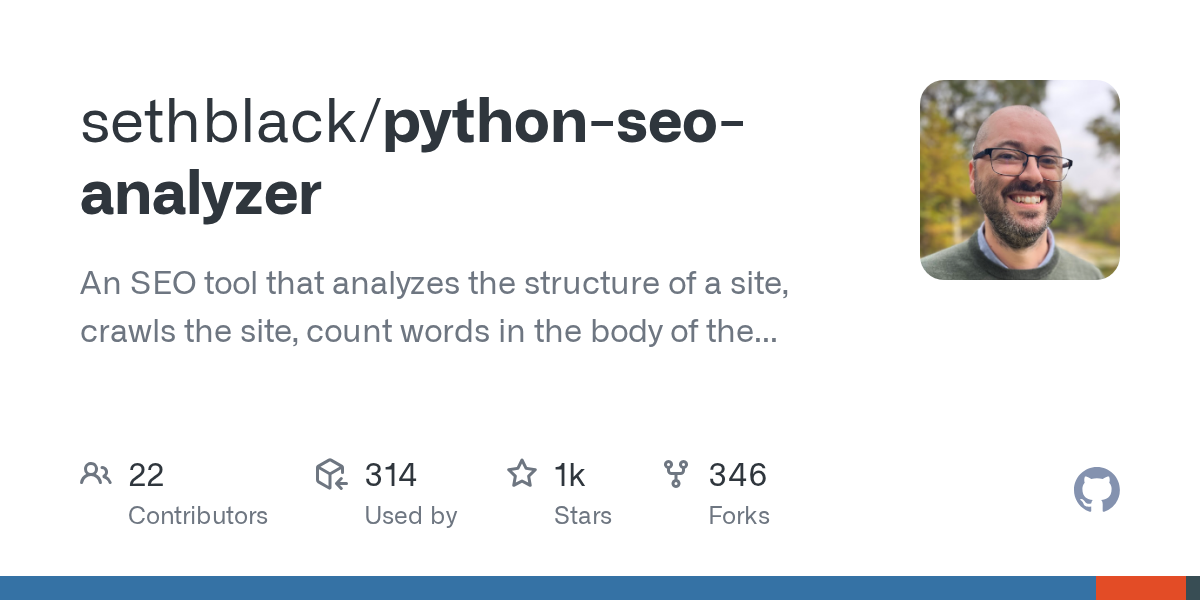
Upfront: I did not build this. It is an open-source project on GitHub (sethblack/python-seo-analyzer, BSD-3-Clause). It is listed here on star count, maintenance activity and how well it fits day-to-day storefront operations.
What it does
- Full-site crawling & structure analysis — follows internal links across your site and maps page structure, titles, and meta information.
- Body-text word frequency — counts words and phrases per page, so you can tell what a page is actually "about" and whether it matches your target keywords.
- Technical SEO warnings — missing titles, descriptions, image alt attributes, and other common issues, listed plainly.
- AI-powered GEO analysis (the new highlight) — uses an LLM to evaluate your content's expertise signals, conversational engagement, and cross-platform presence, with advice aimed at getting cited in AI search.
- Multiple outputs — read results in the terminal, or export HTML / JSON for other pipelines.
How to use it
One line via pip, or keep your environment clean with Docker:
pip install pyseoanalyzer
python-seo-analyzer https://yoursite.com/

# or Docker
docker run --rm sethblack/python-seo-analyzer https://yoursite.com/
On macOS with Homebrew's Python, pip stops with externally-managed-environment — use pipx install pyseoanalyzer instead. Add --output-format html for an HTML report; set ANTHROPIC_API_KEY and add --run-llm-analysis to run the AI GEO evaluation.
When to use it, and when not to
It's great for quick checkups of small-to-mid sites and word-frequency content analysis. If you want deep structured-data (JSON-LD) checks with an A–F graded report, use my own Website SEO Audit Skill; for a self-hosted audit platform with a dashboard, see SEOnaut. The three cover different stages — no overlap.