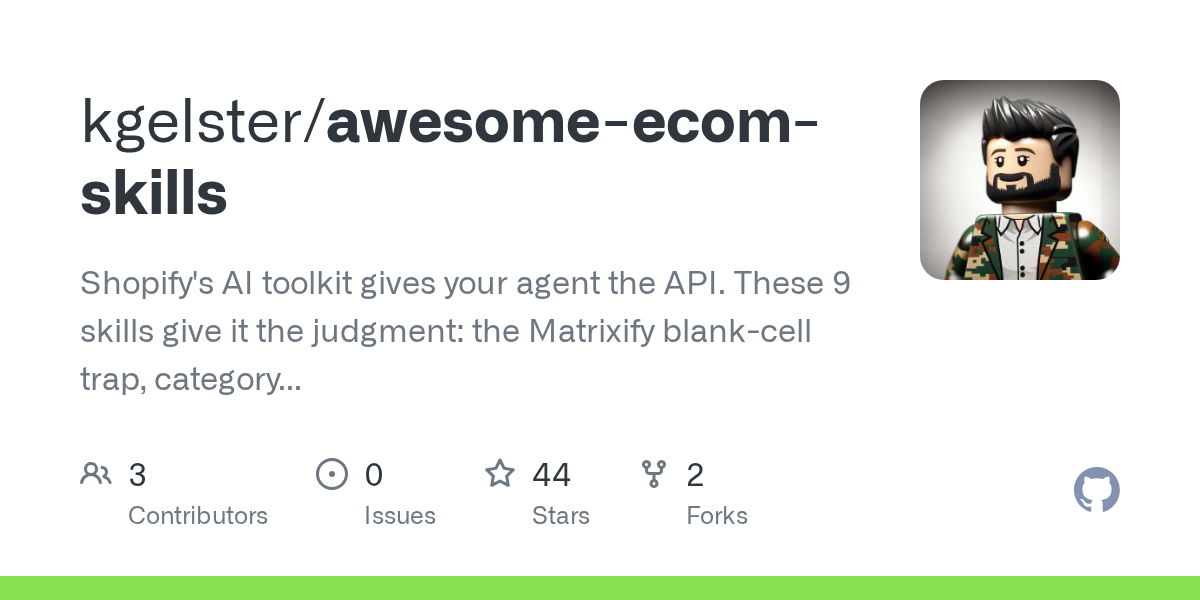
Upfront: I did not build this. It is an open-source project on GitHub (kgelster/awesome-ecom-skills, MIT). It is listed here on star count, maintenance activity and how well it fits day-to-day storefront operations.
What it does
- Audit before you touch anything —
shopify-catalog-auditbuilds a cheap deterministic index and triages by hypothesis, finding missing photos, thin descriptions and broken categorisation in a catalogue too large to read. - Standard taxonomy —
shopify-category-taxonomyassigns Shopify's Standard Product Taxonomy and fills its category metafields, verifying every ID against the source rather than guessing. - Bulk cleanup —
shopify-catalog-cleanupclears the debris the audit finds: archiving dead products, deleting orphaned metafields behind ghost review stars, stripping doubled-up bold HTML. - SEO and alt-text backfill —
shopify-seo-metadataandshopify-alt-textboth run fill-missing-only and preview-first, so nothing you already wrote gets overwritten. - The bulk-import trap —
shopify-matrixifyexists specifically for the classic Matrixify gotcha where a blank cell wipes existing data.
How to use it
The Claude Code plugin marketplace is easiest; the skills CLI works too:
# option 1: Claude Code plugin marketplace
/plugin marketplace add kgelster/awesome-ecom-skills
/plugin install ecom@kgelster

# option 2: skills CLI
npx skills add https://github.com/kgelster/awesome-ecom-skills

# just one skill
npx skills add https://github.com/kgelster/awesome-ecom-skills --skill shopify-matrixify
As the author puts it: Shopify's own toolkit gives your agent the API, this gives it judgment. Run them in order — audit, taxonomy, cleanup, backfill.
When to use it, and when not to
Shopify-specific. For centralised product data on WooCommerce, see UnoPim; for the copy itself, the Visual Copywriting SOP.